Respiratory Assessment of the Newborn
|
Respiratory Assessment of the Newborn |
| http://edcenter.med.cornell.edu/CUMC_PathNotes/Pediatrics/Pediatric.html
http://www.vh.org/Providers/TeachingFiles/PAP/PAPHome.html http://www-medlib.med.utah.edu/WebPath/PEDHTML/PEDIDX.html
http://www.neonatology.org/ref/dubowitz.html http://www.neonatology.org/ref/survival.html http://www.biotech.um.edu.mt/home_pages/chris/Respiration/oxygen5.html
|
Michael R. Jackson RRT Peri/PediSpecialist
Brigham & Women's NICU, Boston, MA With significant use of the on-line guide by Theodore R. Thompson, M.D. |
| Maternal:
1. Diabetes 2. hypertension, preeclampsia - prematurity 3. uteroplacental insufficiency - SGA -IUGR 4. CPD, bicornate uterus, maternal disease |
Delivery
|
| Fetal
1. premature - beta? 2. oligohydramnios or lung growth restriction in chest 3. multiple gestation |
Neonatal Conditions
|
Brigham & Women's Hospital currenly sends most surgical cases to adjoining Children's Hospital.
Medical |
Surgical |
| Respiratory distress syndrome (RDS) | Pneumothorax |
| Wet lung (transient tachypnea, RDS II) | Diaphragmatic hernia/eventration |
| Aspiration syndromes (meconium, blood) | Lobar emphysema |
| Persistent pulmonary hypertension of the newborn | Esophageal atresia with or without TE fistula |
| Pneumonia/sepsis | Pleural effusion |
| Polycythemia - hyperviscosity | Cystic lesions |
| Pulmonary edema | Mass lesions |
| Hypoplastic lungs | Airway disorders (upper, laryngeal, lower) |
| Cardiac lesions | Phrenic nerve paralysis |
| Hypoglycemia | |
| Hypovolemia | |
| Central nervous system |
Signs (15 min)
|
Symptoms (30 min)
|
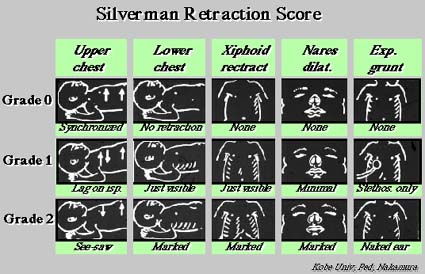 |
Downes Scoring system
|
|
|
|
|
|
Cyanosis
|
|
|
|
|
Retractions
|
|
|
|
|
Grunting
|
|
|
|
|
Air entry
|
|
|
|
|
Respiratory
rate
|
|
|
|
|
> 4 = Clinical respiratory distress; monitor arterial blood gases > 8 = Impending respiratory failure |
|||
E. Arterial Blood Gases
|
|
|
|
|
pH
|
|
|
|
PaCO2
|
|
|
|
PaO2
|
|
|
|
FIO2
|
|
|
|
Base deficit
|
|
|
|
O2 saturation (SaO2)
|
|
|
F. Chest X-Ray - Medical Versus Surgical Causes
| Medical | Surgical |
| Respiratory distress syndrome - hyaline membrane disease | Pneumothorax |
| Wet lung - transient tachypnea | Diaphragmatic hernia |
| Pneumonia | Pleural effusion |
| Aspiration - meconium, amniotic fluid | TE fistula |
| Hemorrhage | Lobar emphysema |
| Pulmonary insufficiency - immaturity | Cyst, masses, phrenic nerve paralysis |
| Congestive heart failure - pulmonary edema | Airway disorders |
G. Guidelines for Monitoring Oxygen Saturation Levels by Pulse Oximetry
|
>95%
|
Pulmonary hypertension (PPHN) |
|
85 (87) - 96%
|
28-34 weeks |
|
85 (87) - 93 (96%)
|
Below 28 weeks gestational age* |
|
90 - 100%
|
First one to two days¦ |
|
>92%
|
Chronic lung disease |
H. Suggested Management of Hypoxemia
| 1. Maintain PaO2
SaO2 |
50-90 torr
85 (87) - 96%* |
BWH Oximeter
alarms 87 low/97 high |
| 2. O2 administration | Warmed, humidified
Headbox, mask/funnel 5 liters/minute, 1/2 inch from nostrils Make small changes in FIO2 (flip-flop) Monitor FIO2, SaO2 |
|
| 3. CPAP - PEEP | ||
| 4. Positive pressure ventilation | ||
| 5. ECMO | Oxygenation index [MAP x FIO2 x 100/PaO2] >40-45 | |
| *SaO2 = oxygen saturation level; maintain SaO2 <96% for preterm infants when possible, higher (>95%) in infants with pulmonary hypertension | ||
| A. Respiratory Distress
1. Downes' score >4-5, low or bSilverman grade
high
C. Suspected Congenital Heart Disease D. Birth Weight <1500 Grams and/or Gestational Age <31-32 Weeks E. Severe Perinatal Distress (combined Apgar score <6) F. Severe Infection G. "Not Doing Well"
|
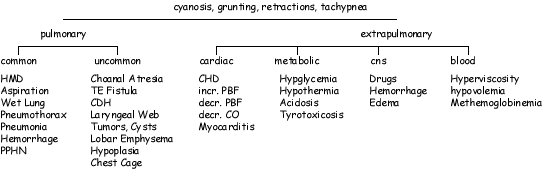
Differential Diagnosis
| Question and Answer (10 min) |
J. Intubation of Newborn Infants
| Birth Weight (grams) / Gestational Age (weeks) | Internal Diameter
(mm)* |
(number at lower lip or base of tape) |
||
| Below 1000 | 2.5 | 4-5 cm | 6-7 cm | 7-8 cm |
| 1000 / 27-28 | 2.5-3.0 | 5 cm | 7 cm | 8 cm |
| 2000 / 32-34 | 3.0-3.5 | 6 cm |
|
9 cm |
| 3000 / 38-40 | 3.5-4.0 | 7 cm | 9 cm | 10 cm |
| 4000 / abover 39 | 4.0 | 8 cm | 10 cm | 11 cm |